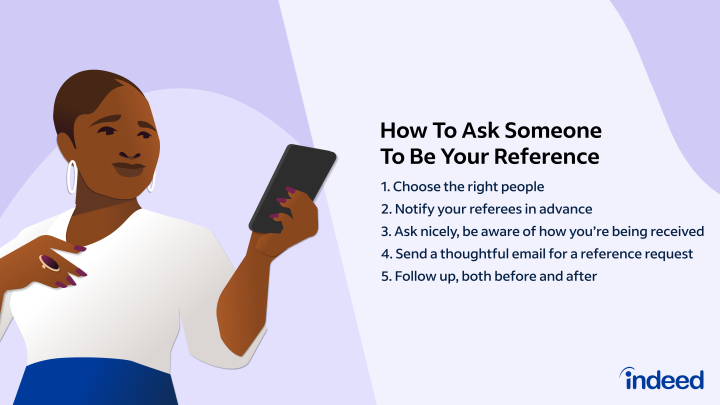
2. Notify your referees in advance
3. Ask nicely, be aware of how you're being received
4. Send a thoughtful email for a reference request
5. Follow up, both before and after At some point during your job search, you may be asked to provide a list of references. It's important to find credible colleagues who can speak positively about your qualities and experience. Learning how to ask someone to be a reference can help you compile an impressive list for potential employers. In this article, you’ll learn how to choose references and how to ask someone via email to be a reference, and you'll find helpful examples to guide you.
Key takeaways:
- Always ask before including someone as a reference.
- Send a polite email or call them on the phone, offering a few details about the request, including timelines.
- After your reference agrees, send them your updated resume and details about the position.
How to ask someone to be a reference via email
You can follow these steps to ask someone to be a reference when applying for a position:1. Choose people who will speak highly of you
You’ll want to consider who your references will be early on in the job search process, as references can be asked for as early as the application phase. Make a list of people who could be potential references. Consider individuals who you believe will speak highly of your accomplishments, work ethic, character and qualifications. References can be any of the following:- Former managers or supervisors
- Former employees
- Former coworkers
- Industry colleagues
- Advisors, teachers, mentors or instructors
- Connections from volunteering, professional clubs or academic groups
2. Get approval before you list a reference
Once you’ve decided on references, ask them for their approval before you list them. You want to avoid a situation where your reference is contacted without knowing you’ve listed them. This could hinder the quality of their reference and may even put the opportunity at risk. The person giving you a reference may be required to write a letter, fill out a questionnaire, or speak to someone from human resources on the phone. Providing this favor is no small task. It can be helpful to give your potential reference plenty of time to consider the request, and thank them for their time. Related: Types of References and How To Get Them3. Ask politely and be aware of how you’re being received
If it’s been a while since you’ve communicated with a potential reference, it may be helpful to connect the dots between the past and the present, including what you worked on together and where you are in your current career path. Providing your resume is an easy way to do this. It's advisable to always give your potential reference an option to decline by using language like, “Would you feel comfortable being a reference for me?” or, “I understand your time is valuable, so don’t hesitate to let me know if this isn’t a good time.” If they show any hesitation, gracefully back out of the invitation and move down your list to the next option. It’s better to preserve the relationship in the long run. Related: What To Do When You've Received a Bad Reference4. Provide them with helpful details
Once you’ve provided your list of references to your potential employer, you can send a quick email to let each reference know which company will be reaching out and, if you know the details, what information the company will be requesting. You can provide your references with a brief overview of what the role is and any specific information you’d like them to speak to, as this will make it easier for your reference to know what to say. Here’s an example email for how to update your references: Subject line: Reference request – update Dear [Reference’s name], Thank you again for being a reference for me. I wanted to let you know that I’ve completed my interviews for the [job title you interviewed for], and ABC Company may be contacting you soon. I’ve attached the job description below so you’re aware of the qualities they’re seeking in a candidate. Let me know if there’s any additional information I can provide you. Thank you![Your name] Related: 33 Reference Check Questions (And Steps To Take To Prepare)
5. Follow up with a thank you
Follow up with your reference to thank them after every reference they provide. You can do so through a handwritten letter or a thoughtful email. Then, if you are hired for the position, you can take a moment to celebrate by sending a quick email to your references to let them know you’ve accepted a position and that you’re grateful for their help on your behalf. You might consider letting your reference know that you’re willing to return the favor if ever required. Here’s an example email for how to thank your reference: Subject line: Reference request – Thank you! Dear [Reference’s name], I’ve just accepted the [job you interviewed for] role at ABC Company. Thank you so much for sending a reference on my behalf. I sincerely appreciate it. I’d be happy to return the favor by serving as a reference for you in the future. Thanks again,[Your name] The model shown is for illustration purposes only, and may require additional formatting to meet accepted standards. "Thank You Letter Format" is the title of this infographic that shows an image of an example letter. On the left side of the infographic, a numbered list points to each section of the email:
- Start with a greeting.
- Share your gratitude with specific examples.
- Include any details from your conversations.
- Close with any additional thoughts or information.
- End with a polite closing.
Example of an email asking for a reference
Sometimes a phone call or in-person meeting is a good idea for requesting a personal reference, but you can also start out with an email. Below is an example email template you can easily adapt, depending on the position you’re applying for and the relationship you have with your potential reference: Subject line: Reference request for [Your Name] Dear [Recipient Name], I hope you are well! [Insert a pleasantry (e.g., ‘How is your family?’ or ‘It was great seeing you at the Tech event last month.’)] I am currently seeking employment as a [job title you’re applying for] and am wondering if you’d be comfortable providing a reference for me. Having worked with you for several years at ABC Company, I believe you can provide potential employers with specific information about my skills that will improve my chances of getting the job. Attached is my current resume. Please let me know if you require any additional information to act as a reference on my behalf. If now is not a good time for you, don’t hesitate you let me know. Thank you so much for considering my request. Thanks again,[Your name]
[Your number]
[Your email]